English| EUR
Suggested for you
More currencies
Choose a language
The Hill of Crosses sits 133 kilometres north of Riga, just outside Šiauliai in northern Lithuania. Most visitors travel by bus via Šiauliai or join a private tour that handles the cross-border journey and site access in a single booking. The pilgrimage site itself is free to enter and open around the clock.
Quick answer
The journey from Riga to Hill of Crosses takes three to four hours depending on your transport choice. Direct buses run from Riga International Coach Terminal to Šiauliai several times daily, with the site located twelve kilometres north of the city centre. Private tours and transfers handle the full route in one leg, while independent travellers typically combine the Riga-Šiauliai bus with a local taxi or rideshare for the final stretch.
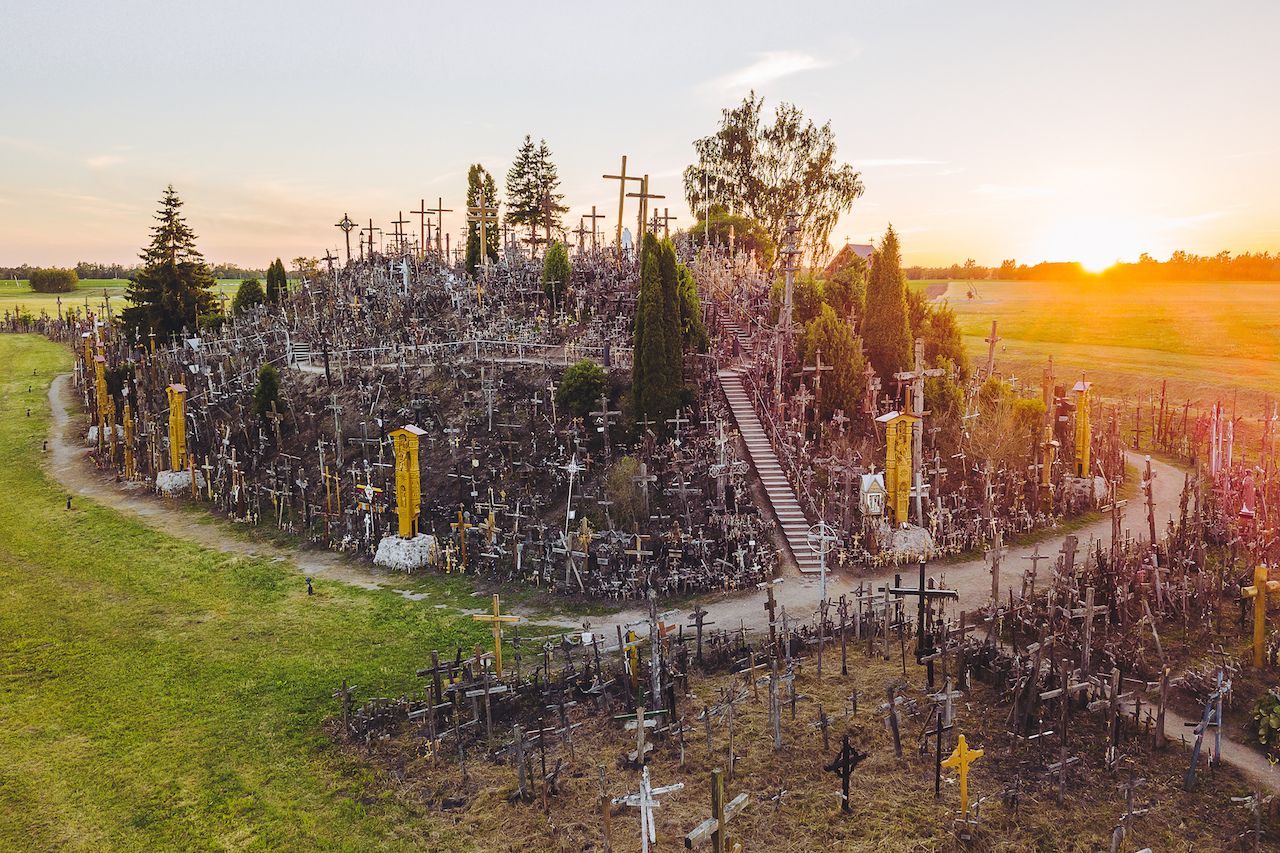
More than two hundred thousand crosses stand on a low earthen mound twelve kilometres north of Šiauliai, the accumulation of four centuries of devotion, defiance and memory. The site began as a hill of wooden crosses planted after the 1831 uprising against Russian rule, and grew through waves of Soviet suppression into the dense forest of metal, wood and rosaries visible today. Pilgrims still arrive daily to add crosses of their own, and the sound of wind moving through thousands of metal chimes gives the site an atmosphere unlike any other landmark in the Baltic region. Travelling from Riga to Hill of Crosses requires crossing the Latvia-Lithuania border and navigating the final rural stretch beyond Šiauliai. The Riga-Šiauliai corridor is well served by intercity buses operated by Lux Express and Ecolines, with most departures leaving from Riga International Coach Terminal on Prāgas iela. Journey time to Šiauliai ranges from two and a half to three hours depending on routing and border checks. From Šiauliai bus station, the site lies roughly twelve kilometres north along the A12 highway near the village of Jurgaičiai, reachable by taxi in fifteen minutes or by local bus during weekday service windows. Many visitors choose a guided day trip that bundles transport, border formalities and site time into a single departure. These tours typically leave Riga mid-morning, spend ninety minutes to two hours at the pilgrimage site, and return by late afternoon. The fixed schedule suits travellers with limited time, while independent bus travel offers flexibility to extend the visit or explore Šiauliai itself. The site remains open twenty-four hours and charges no entrance fee, so arrival timing depends entirely on crowd preference and light. Early morning visits between six and ten offer the quietest experience, with mist often clinging to the crosses and few other visitors present. The Hill of Crosses functions as both active pilgrimage destination and open-air monument, so no ticket booth or formal visitor infrastructure exists. A small car park, a single souvenir kiosk and a modest path system serve the site, with the rest left deliberately unmanicured. Visitors walk freely among the crosses, and many bring their own to plant. The site's endurance through repeated Soviet demolitions in the 1960s and 1970s made it a symbol of peaceful resistance, and Pope John Paul II's 1993 visit cemented its status within European Catholic memory. The journey from Riga to this quiet corner of Šiauliai District remains one of the most direct routes to a landmark that resists easy categorisation.
“The sound of wind moving through thousands of metal chimes gives the site an atmosphere unlike any other landmark in the Baltic region.”
The Hill of Crosses is located in Jurgaičiai, within the Šiauliai District Municipality of Lithuania. Reaching the site from Riga typically requires traveling south to the city of Šiauliai before completing the final leg to the destination.
A7 (Latvia) and A12 (Lithuania) to Šiauliai
Direct bus Riga to Šiauliai Central Bus Station
Direct transfer from Riga to Jurgaičiai
Local bus from Šiauliai to Domantai stop, then walk
Upon arriving in Šiauliai, visitors must travel approximately 12 kilometers to the site; local buses or regional taxis from the city center are the most common methods for this final segment.
The Hill of Crosses is accessible to visitors every day of the week, twenty-four hours a day. This schedule allows for flexibility when planning your arrival from Riga.
The Hill of Crosses emerged in the mid-19th century as a site of quiet defiance. After the failed 1831 Polish-Lithuanian uprising against Russian imperial rule, families began placing crosses on this mound near Šiauliai to honor the fallen. The practice deepened after the 1863 January Uprising, when thousands more crosses appeared—each one a silent act of mourning and resistance. By the early 20th century, the hill had become a recognized pilgrimage destination, its crosses numbering in the thousands. Soviet occupation brought systematic destruction. Authorities bulldozed the site in 1961, 1973, and 1975, attempting to erase what had become a symbol of Lithuanian Catholic identity and national memory. Each time, locals returned under cover of darkness to replant crosses. The hill survived as an act of collective stubbornness, its crosses multiplying faster than the state could remove them. Independence in 1990 transformed the site from a covert memorial into a UNESCO-recognized landmark. Pope John Paul II visited in 1993, cementing its status as a pilgrimage destination for those traveling from Riga to Hill of Crosses and beyond. Today, an estimated 100,000 crosses cover the mound—large wooden crucifixes, tiny metal pendants, rosaries draped over older monuments. Visitors still add crosses daily, continuing a tradition that spans nearly two centuries. The site remains open at all hours, free to enter, and entirely shaped by the hands of pilgrims rather than institutional design.
A few practical steps will help you make the most of the journey from Riga.
Everything you need to know about riga to hill of crosses
Travelers typically use private car transfers, organized shuttles, or bus connections from Riga to reach the Šiauliai region. Many choose a guided riga to hill of crosses tour to simplify navigation across the border.
Entrance to the site is 0 EUR, meaning there is no fee for individual visitors to access the area. You can explore the sanctuary of wooden crucifixes and metal icons freely.
The best arrival window for your riga to hill of crosses trip is 06:00–10:00. Arriving early helps you avoid crowds and enjoy a peaceful, atmospheric experience in the morning light.
The site is accessible every day of the week, with opening hours from 00:00–23:59. This 24-hour access allows for flexible planning regardless of your transport schedule.
Depending on your chosen mode of transport, the drive from the Latvian capital typically takes several hours. Please consult our dedicated transport section for specific routing options from Riga to the site.
Yes, families are welcome to explore this significant monument, which serves as a site of historical and cultural pilgrimage. The open-air nature of the site makes it easy to walk through with children.
Sturdy footwear is recommended for walking along the paths among the thousands of crosses. Since it is an outdoor space, check the local weather forecast to ensure you are prepared for seasonal conditions.