English| EUR
Suggested for you
More currencies
Choose a language
The Hill of Crosses lies 12 kilometers north of Šiauliai in northern Lithuania, with no direct rail service to the site itself. Reaching it from Riga requires a train to Šiauliai followed by a regional bus or taxi for the final stretch. This guide breaks down the rail connection, transfer logistics, and what to expect when you arrive.
Quick answer
There is no direct train from Riga to the Hill of Crosses. The journey requires a rail connection from Riga to Šiauliai, Lithuania—served by international trains that take approximately three to four hours—followed by a 20-minute bus ride or taxi from Šiauliai station to the pilgrimage site. Buses to Jurgaičiai village depart from the station forecourt several times daily, with the stop located 400 meters from the site entrance.
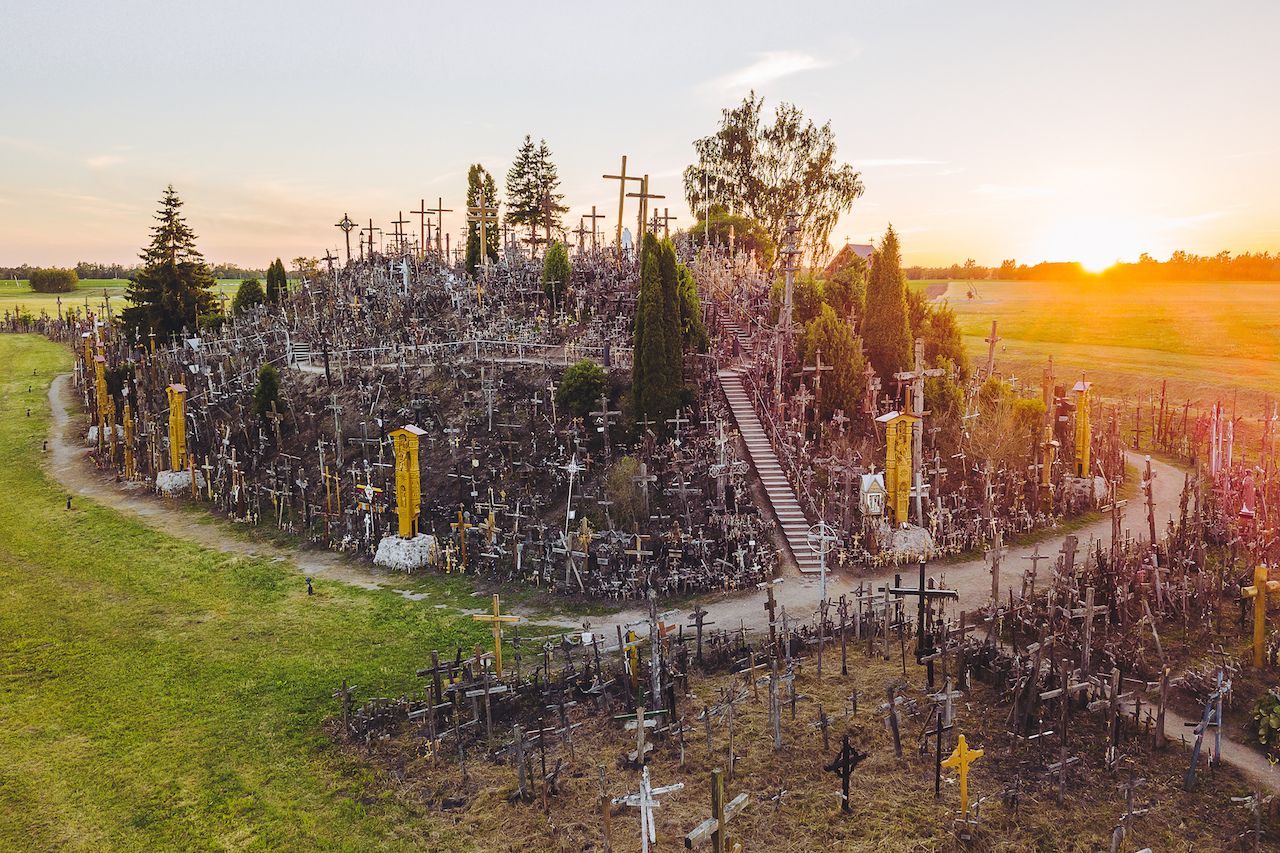
The Hill of Crosses accumulates more than 100,000 crosses, rosaries, and devotional objects across a low earthen mound that has served as a place of pilgrimage since the mid-19th century. Its location in rural Šiauliai district, far from Lithuania's main rail corridors, means that visitors traveling by public transport from Riga face a two-stage journey: an international train to Šiauliai followed by a local bus connection. The Riga to Hill of Crosses train route begins at Riga Central Station, where several daily services operate to Šiauliai on the Riga–Vilnius and Riga–Kaunas lines. These international trains cross the Latvian–Lithuanian border at Meitene and continue south through the flat agricultural plains of northern Lithuania. Journey times range from three to four hours depending on the service, with most trains making intermediate stops at Jelgava and Joniškis. Upon arrival at Šiauliai station, travelers exit onto the forecourt where regional bus services to Jurgaičiai village wait at marked bays. The bus journey takes 20 minutes and terminates at a roadside stop on the edge of the village, from which the site entrance is visible across an open field. No rail line extends to the Hill of Crosses itself. The site occupies a hillock beside the A12 highway, surrounded by farmland and lacking the population density that would justify a dedicated station. Šiauliai, Lithuania's fourth-largest city, serves as the natural gateway. The Riga–Šiauliai railway connection is maintained by both Latvian and Lithuanian state operators, with ticketing available at the station or through national rail booking platforms. Departure frequencies vary by season, with additional services added during summer months when pilgrimage traffic increases. Travelers arriving by train should note that the site operates on a free-admission basis and remains open seven days a week. The bus stop lies 400 meters from the entrance gate, connected by a paved footpath that runs parallel to the highway. Taxis wait at Šiauliai station and quote fixed fares to the site, offering a faster alternative to the scheduled bus service for groups or those traveling with mobility constraints.
“No rail line extends to the Hill of Crosses itself—the site occupies a hillock beside the A12 highway, surrounded by farmland and lacking the population density that would justify a dedicated station.”
There is no direct train connection between Riga and the Hill of Crosses. The most practical approach is to travel to the city of Šiauliai by bus or train, followed by a short local transit connection to the site.
Lux Express or Ecolines from Riga Coach Station to Šiauliai Bus Station
Latvian Railways/LTG Link via Jelgava to Šiauliai Station
Regional road A12 from Šiauliai towards Jurgaičiai
Suburban bus from Šiauliai Bus Station towards Joniškis, alighting at the 'Domantai' stop
If arriving by local bus at the Domantai stop, you must walk approximately 2 kilometers from the main road to reach the Hill of Crosses. Taxis are available in Šiauliai and provide the most direct transit to the site entrance.
The Hill of Crosses is open to visitors throughout the week with varying hours on weekends. Please refer to the schedule below when planning your visit.
The Hill of Crosses is a public site managed by the local municipality and does not require an admission ticket for entry. Visitors may access the grounds without paying any fees.
Verdict: A typical adult pays 0 EUR to enter, as there are no ticket tiers or admission costs for this site.
The best arrival window is 09:00–11:00, which provides fewer crowds and superior lighting conditions for photography. Planning your trip during this period allows for a more contemplative experience before peak daily visitor traffic arrives.
Warm, 15°C to 23°C; often sunny.
Peak season offers the most daylight hours for travel from Riga.
Cool, 5°C to 14°C; potential rain.
Lower humidity and soft light create clear conditions for viewing the site.
—
Arriving early in the week avoids the larger weekend groups arriving from neighboring regions.
Cold, -5°C to 3°C; frequent snow.
The site remains accessible, though visitors should prepare for icy paths and limited daylight.
Verdict: For the quietest experience and optimal light, aim for a weekday morning during the shoulder months of May or September.
The Hill of Crosses emerged in the mid-nineteenth century as an act of defiance. Following the failed 1831 uprising against Imperial Russia, Lithuanian families began placing crosses on this low mound near Šiauliai to honor the fallen rebels whose bodies were never returned. By the 1860s, after another crushed rebellion, the hillock had become a pilgrimage site—each cross a quiet assertion of identity under occupation. Under Soviet rule the site became a flashpoint. Authorities bulldozed it at least three times between 1961 and 1975, removing thousands of crosses and threatening locals with arrest. Yet within days of each clearing, new crosses reappeared, planted under cover of night. The riga to hill of crosses train route, though indirect, became a covert artery for pilgrims smuggling wooden crosses from Riga and other Baltic cities during the thaw of the 1970s. The KGB monitored the site, but suppression only deepened its symbolic weight. After independence in 1991, the Hill of Crosses transformed from resistance monument to living shrine. Pope John Paul II celebrated Mass here in 1993, and a Franciscan monastery was established nearby in 2000. Today more than 100,000 crosses—from towering carved monuments to tiny rosary pendants—blanket the slopes. Visitors arriving via the Šiauliai connection still add their own, continuing a tradition that began nearly two centuries ago. The oldest weathered timber crosses, dating to the 1920s interwar period, stand near the summit, gray and listing but still rooted.
Lithuanian families plant first crosses after the November Uprising against Tsarist Russia.
Site expands following the January Uprising; becomes a pilgrimage destination.
Soviet authorities bulldoze the hill repeatedly; crosses reappear within days each time.
Documented as a resistance symbol; KGB surveillance intensifies but fails to halt new placements.
Pope John Paul II visits and celebrates Mass, declaring the site a place of hope and peace.
Franciscan monastery established adjacent to the hill to serve pilgrims year-round.
Recognized as a Lithuanian cultural heritage site; conservation efforts begin on oldest crosses.
Crossing from Latvia into Lithuania and visiting an outdoor pilgrimage site requires a few practical preparations.
Everything you need to know about riga to hill of crosses train
There is no direct riga to hill of crosses train service because the tracks do not connect these two specific points. Travelers typically take a train or bus to Šiauliai and then utilize a taxi or local bus to reach the site. Planning your riga to hill of crosses train route requires transferring at Šiauliai station. Visitors often find that booking a dedicated transfer simplifies the journey compared to navigating local schedules. The Hill of Crosses has an entrance fee of 0 EUR. This historic site remains open to the public daily without any admission costs. For the best experience, plan your arrival between 09:00 and 11:00. This window offers fewer crowds and better lighting conditions for viewing the thousands of crosses. Many visitors opt for a Riga to Hill of Crosses tour to manage the logistics of crossing the international border efficiently. These tours provide direct transportation, which is often more convenient than attempting a riga to hill of crosses train journey with multiple transit changes. Public transport is available, but it requires coordinating regional bus or rail schedules to reach Šiauliai first. Once in Šiauliai, you must arrange local transit for the final leg to the Jurgaičiai site. Using a riga to hill of crosses train combination is possible if you are comfortable with regional travel logistics.